
en
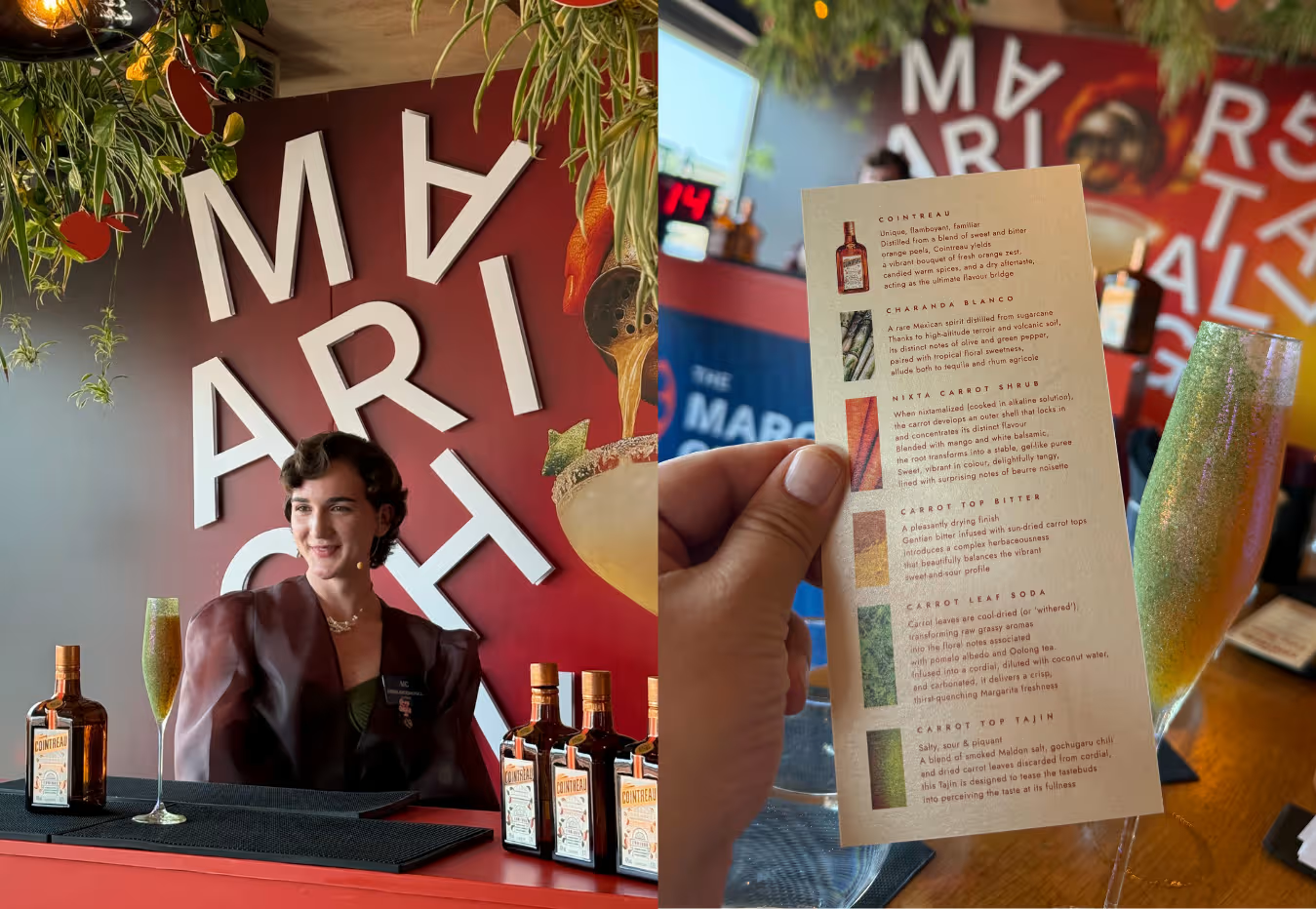
The winner of the European Semi-Final of the Cointreau Margarita Challenge 2026 talks about her transition from graphic design to bartending, competitions as tools for self- discovery, and her preparation for the global final in France.
By Babis Kaidalidis
As a judge, you are often asked to assign numbers to things that do not easily fit on a score sheet: creativity, presence, a person’s ability to communicate an idea, and to create a connection with their audience.
At the European Semi-Final of the Cointreau Margarita Challenge 2026 in Athens, together with Lukasz Chodacki and Manos Mantzaridis, we had to evaluate bartenders from nine European countries. At this level, everyone can create a technically sound and flavor- balanced cocktail. The difference lies elsewhere: in the coherence of thought, in authenticity, and in the way the contestant manages to bring you into their world.
This was, for me, the strongest element of Dariia Khodakivska.
Dariia, who represented Ukraine and won the ticket to the global final, did not start her career behind a bar. For five years, she worked in graphic design and marketing. However, at some point, she realized that what she was missing from her office routine was human contact. The war had made her realize that she was young and lacked enough experiences —something I understand led her to make decisions on a different basis.
Her transition to hospitality was not just a career change. It was a return to something that came naturally to her: welcoming people, communicating with them, and creating experiences. And this previous professional life was not left behind. On the contrary, it became part of her identity as a bartender.
When she creates a cocktail for a competition entry, Dariia approaches the process like a branding assignment. There is a brief, a goal, specific constraints, an identity, and, above all, an audience you need to address. In this year’s challenge, where every participant had to work with a random secret ingredient, the constraint did not function as an obstacle. It became a creative tool.
This is one of the greatest values of a well-designed competition: it doesn’t just ask the bartender to repeat what they already know. It forces them out of their routine and to find solutions where there are no ready-made recipes.
Dariia describes competitions as "quest chambers"—like test rooms you enter to see how you react when pressure increases. Not to prove to others how good you are, but to discover for yourself your true capabilities and the areas in which you need to evolve.
The same applies to her presentation. She does not believe in memorizing a text that must be recited perfectly, word for word. She prefers a flexible framework that allows her to "read" the audience and react to them. She uses music, visuals, and touch as tools of a multi- sensory experience.
These elements can easily become showmanship without substance. But when they serve a clear idea, they cease to be tricks and become true hospitality. You are not just presenting a cocktail. You are inviting people to participate in its story.
In our conversation, we also focused on the Ukrainian bar scene. We agreed that the high level of competitions and the frequency with which bartenders test their strengths create an environment of rapid professional development.
Talent does not appear in a vacuum. It needs a community, demanding colleagues, proper feedback, mentors, and businesses that are willing to invest in their people's growth. As the level of such an ecosystem rises, so do the people operating within it. This is perhaps the greatest value of competitions: it is not the distinction and publicity, but the fact that they raise the common bar.
Dariia's preparation for the global final in November, which will take place in Angers and Paris, is still in the strategic stage. She is building a detailed mind map, organizing her ideas, and seeking out bars and people who can support her in her training.
And this, for me, shows maturity. True evolution is not an individual sport. Asking for help, seeking knowledge, and allowing others to improve your work is not a weakness. It is professionalism.
As a judge, I saw Dariia win a demanding European competition. But as a member of the wider European bar community, I saw something even more important: a new professional who combines different experiences, works with method, seeks connection with people, and views competition as an opportunity for self-discovery.
In the global final, she will represent Europe, and with her, she will carry a piece of our entire European community.
Good luck, Dariia. The next challenge has already begun.

.png)

.avif)